Selecting the right custody model for your business
How Privy enables flexible custody across products, users, and markets through a single wallet infrastructure

Debbie Soon
|Sep 16, 2026

As more businesses build with stablecoins, custody quickly becomes an important question: who actually controls the assets?
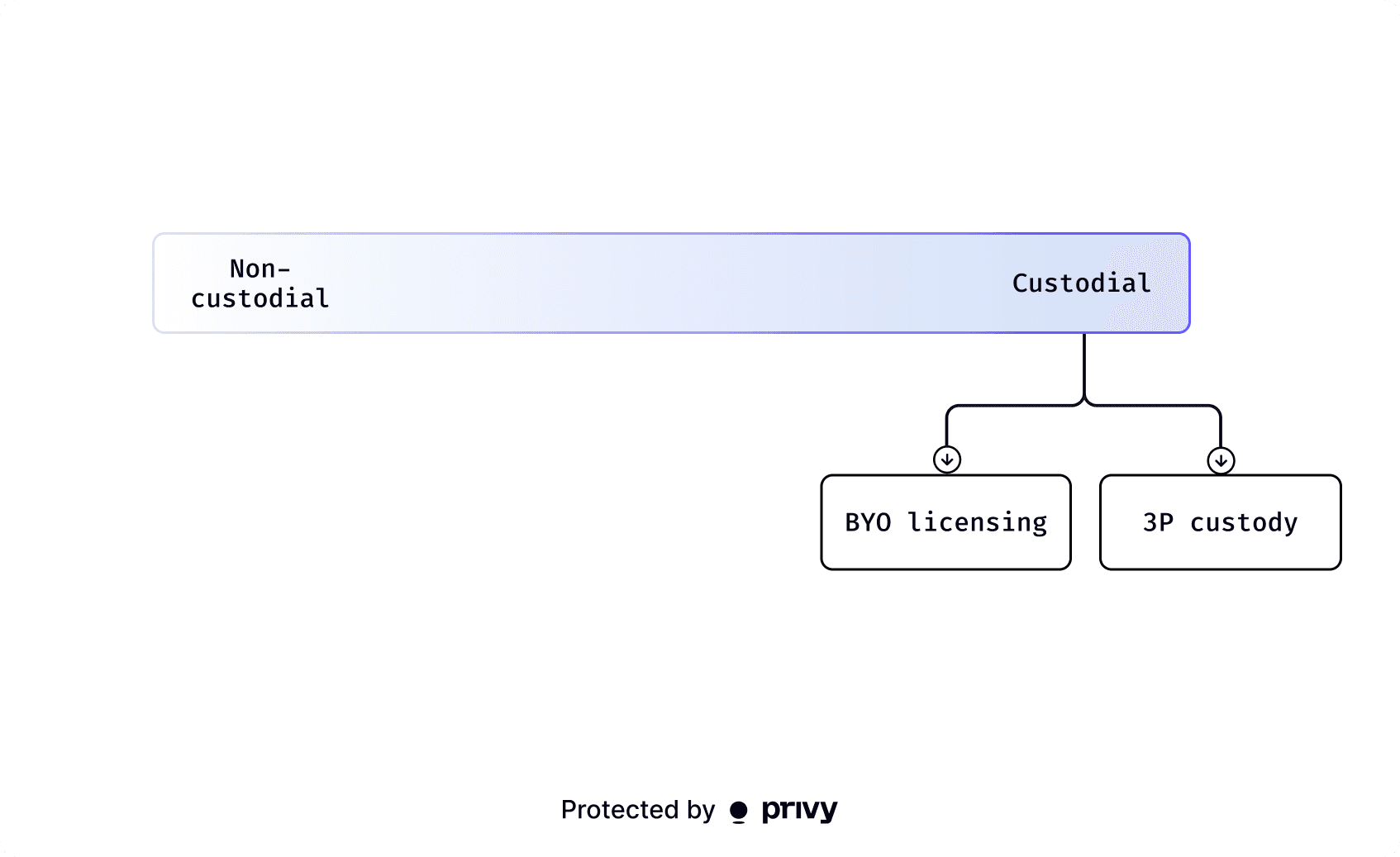
The answer is often framed as a choice between custodial and non-custodial wallets. In practice, custody exists on a spectrum, shaped by how a wallet is configured and what permissions exist between different parties.
At its simplest, digital asset custody comes down to who controls the keys to a wallet, and therefore the assets inside. That means looking at who can access or export the keys, who can initiate transactions, and whether the user has delegated permission for someone else to act on their behalf.
Those details become especially important as businesses expand globally. Custody rules vary across jurisdictions, so the same product may need different approaches depending on how it's configured and where it operates.
4 things to understand about custody
Custody is often discussed in absolutes, when the reality is more nuanced. Here are four things businesses should understand when choosing how to structure custody.
1. Custody exists on a spectrum
Custodial and non-custodial are useful categories, but specific implementation choices can affect where a product falls between them. That means two seemingly similar products may ultimately take different approaches.
2. Being able to move funds doesn’t mean you own them
Ownership and signing authority are distinct. A user can retain ownership of a wallet while giving a developer permission to take specific actions on their behalf. With Privy, developers can use delegated signers and policies to narrowly define what actions can be taken, while the user retains underlying control of the wallet.
3. Non-custodial wallets don’t require a worse user experience
Non-custodial doesn't mean asking users to manage seed phrases or understand blockchain infrastructure. Users can access wallets through familiar login methods, recover access, and interact entirely through the product they already use. Custody and user experience are separate design decisions.
4. Technical configuration alone doesn’t determine your regulatory obligations
How a particular setup is treated can depend on its specific configuration, the product and use case, and the jurisdictions where a business operates. Different businesses may also make different implementation choices based on their regulatory requirements and risk appetite.
Privy provides the infrastructure and configurability to support different custody models, but businesses should work with their own legal counsel to determine the appropriate setup for their product.
Two ways to approach custody with Privy
Privy gives businesses the infrastructure to support two broad models: non-custodial and custodial wallets.
With non-custodial wallets, the user or business ultimately controls its own assets. Developers can still build familiar embedded experiences and use delegated signers and policies to enable specific actions with user consent.
With custodial wallets, assets are held on behalf of users. Privy supports two approaches:
Bring your own licensing: Businesses that hold the appropriate licenses can use Privy infrastructure to custody user assets directly. This gives them access to Privy's full wallet stack while maintaining responsibility for their own custody and compliance obligations.
Use a third-party licensed custodian: Businesses can provision wallets backed by a licensed custody partner through Privy, including in markets where they don't hold their own licenses. These wallets are subject to the custodian's supported geographies, assets, chains, policies, and other requirements.
Flexible custody for a global business
Custody requirements can vary by product, user, and market, and they can change as a business grows.
Privy's flexible custody architecture lets businesses support different custody models through the same wallet infrastructure and adapt their setup over time, without rebuilding their product. Privy provides the wallet infrastructure and cryptographic guarantees underneath these experiences, but does not itself serve as custodian of user assets.
If you'd like to discuss custody options for your business, get in touch with our team.


