How to let your AI agent trade onchain with Privy and 0x
How programmable wallets and aggregated liquidity turn agents into autonomous traders

0x
|Mar 19, 2026

Building agents that trade on crypto rails? Get started with a 0x account and Privy wallets in minutes.
⎯⎯⎯⎯⎯⎯⎯⎯⎯⎯⎯⎯⎯⎯⎯⎯⎯⎯⎯⎯⎯⎯⎯⎯⎯⎯⎯⎯⎯⎯⎯⎯⎯⎯⎯⎯⎯⎯⎯⎯⎯⎯⎯⎯⎯⎯⎯⎯⎯
AI agents are getting good at reasoning, planning, and acting. What will make them capable is the ability to transact independently.
We want agents to buy things and do things on our behalf: purchase compute, pay for API calls, execute trades, manage subscriptions, and move funds between services. Every one of these actions requires the ability to hold and move money. Without it, agents can analyze a market but can't place a trade. They can find the cheapest data provider but can't pay for access. The gap between deciding and doing is simply a financial one.
Why agents end up onchain
Traditional payment rails were built for humans. These systems require human identity at every step, which agents don't have. They can't open bank accounts, pass Know Your Customer (KYC) checks, or get issued credit cards; they exist outside the trust structures that traditional finance is built on.
Crypto wallets carry no such constraint. They can be attached to anything: a server, an application, a smart contract, an agent. No identity verification is required to hold and move funds — from the moment a wallet is provisioned, an agent has permissionless access to a global financial system.
Stablecoins add a second structural advantage. They are programmable money that moves without accounts or billing relationships, which means agents can send and receive value as part of their execution logic rather than through a separate payment flow.
But holding funds is only the first step. To participate fully in onchain economies, agents also need to trade one asset for another: they need to enter and exit positions, rebalance across assets, and route through fragmented DEX liquidity, all programmatically, efficiently, and without a human in the loop.
Building onchain agents
The need for agents to hold, move, and trade funds opens two building opportunities for developers.
The first is applications that deploy trading agents on behalf of users. Bankr, which lets users trade from social feeds using natural language commands and has recently enabled agents to launch their own tokens, is already doing this in production. The developer builds the app, the app creates and manages agents, and those agents execute trades for end users. This could be an AI trading companion embedded in a social feed, a portfolio manager that rebalances automatically, a bot that dollar-cost averages into a position over time, and so on.
The second is onchain services and dApps where agents show up as customers. The developer builds a protocol or service, and autonomous agents are among the users consuming it. Platforms like Moltbook, where AI agents post, interact, and coordinate with each other autonomously, hint at where this is heading. Those agents arrive with their own wallets and need to swap tokens as part of interacting with the product, whether that means converting to the right input token, meeting a collateral requirement, or moving into a yield position.
Both paths require the same core primitives: programmable wallets and reliable swap execution.
The stack: Privy + 0x
A wallet without access to liquidity can hold funds but cannot act on a trading decision. A swap API without a programmable wallet still requires a human to approve and sign. Together, Privy and 0x close that gap.
Programmable wallets for agents
At Privy, we think about wallets as programmable accounts. An agent's wallet is embedded directly into how it operates.
Privy's embedded wallets allow agents to hold funds, authorize spend, and sign transactions autonomously, all within defined guardrails. Developers spin up wallets programmatically with policies attached at creation. The result is plug-and-play wallet infrastructure that is customizable from day one:
Spending limits, approved tokens, and per-transaction caps
Allowlisted contracts that define exactly what an agent can interact with
Built-in gas sponsorship so agents operate without holding native gas tokens
Flexible custody across EVM, Solana, and other supported chains
Private keys are never exposed in agent prompts, memory, or logic. All sensitive material is stored in hardware-isolated trusted execution environments (TEEs), and programmable policies can be enforced before any transaction is signed to ensure that agents performed within human-defined guardrails.
Wallet infrastructure is what allows agents to participate in economic systems. But participating in an economy means more than just holding funds.
Aggregated liquidity for agents
Where Privy gives an agent the ability to hold funds and authorize spend, 0x gives it the ability to act on a trading decision.
The 0x Swap API aggregates DEX liquidity across 500+ onchain sources to find best-price execution for any token pair, with built-in slippage protection and MEV-aware routing. Alongside the Swap API, 0x is also building dedicated Solana and Cross-Chain APIs, giving agents access to liquidity across chains and ecosystems through the same seamless developer experience. The agent queries a price, receives an executable quote, and submits the transaction. It moves from intent to execution in a single API call.
How they work together
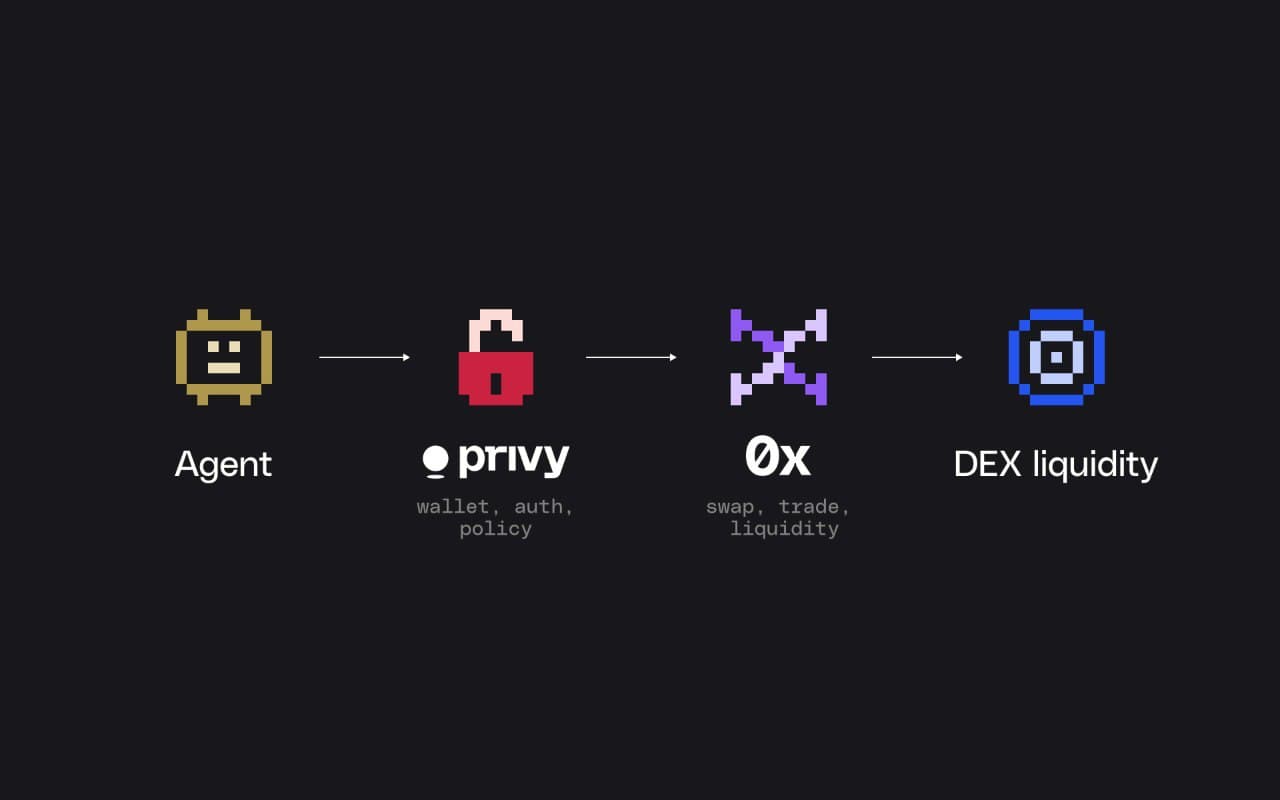
An agent provisions a wallet through Privy, funds it, and begins trading via 0x within a single execution flow. There is no separate wallet client to configure and no manual exchange to set up.
The key unlock is that decision and execution happen in one loop. An agent reads a signal, decides to trade, and calls 0x for a quote and executable transaction. The Privy wallet evaluates that transaction against its policy guardrails before signing and submitting onchain. If the trade exceeds a spending limit or targets a contract outside the allowlist, it is rejected before funds can move.
The combination collapses the gap between intent and execution into a single programmatic flow where agents trade autonomously within enforceable constraints.
What you can build
Trading and portfolio management
Agents can manage funds within predefined constraints and without manual intervention. This includes:
Executing swaps based on market conditions
Rebalancing portfolios automatically
Running Dollar Cost Average (DCA) strategies
Earning from liquidity provision
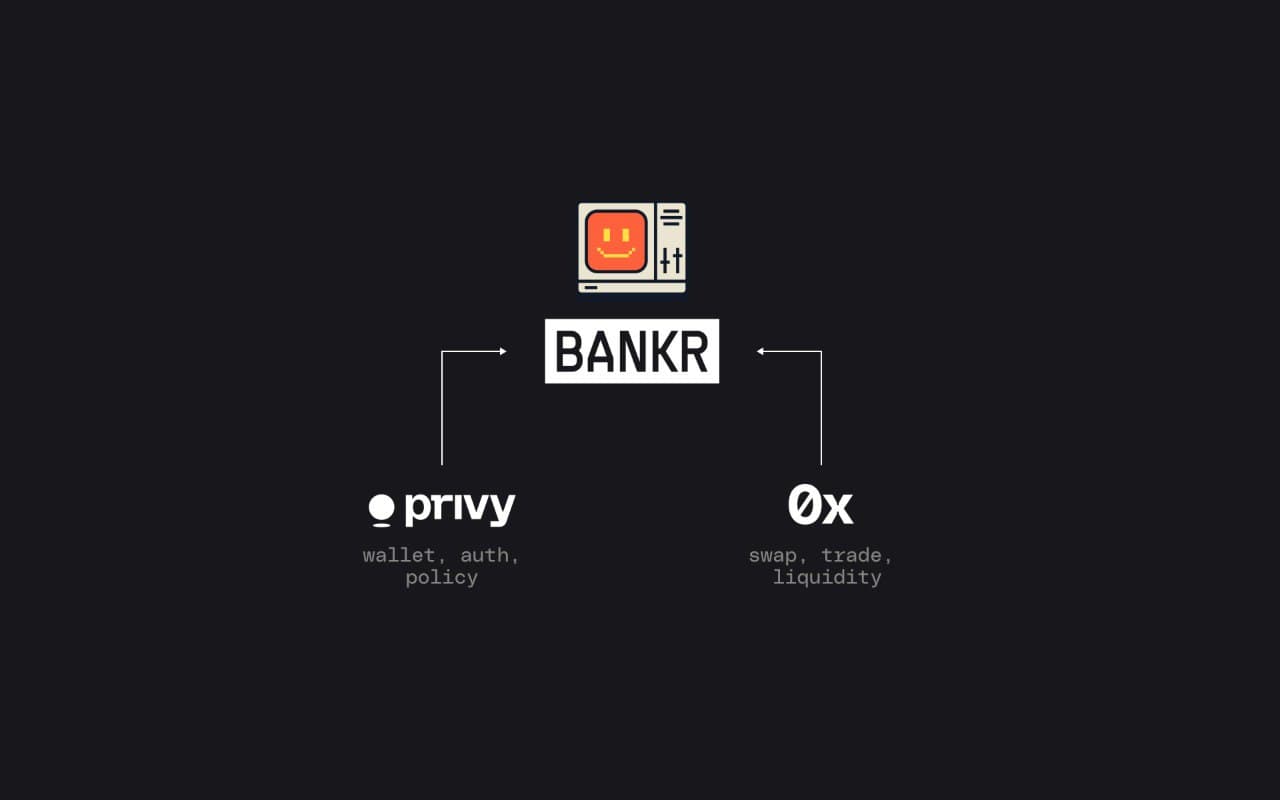
Bankr is an AI trading companion that lives in social feeds. Users trade directly from Farcaster, X, Telegram, or Discord using natural language commands. A user types "buy $200 of $TOKEN" in a reply, and Bankr handles everything end to end: Privy wallets power the custody and signing, 0x powers the swap routing and price optimization. The user never interacts with a DEX interface or approves a transaction manually.
Payments and commerce
Trading is one category of financial action, but agents also need to pay for things. An agent with a Privy wallet and a policy-defined budget can pay for compute, data feeds, or any service that accepts onchain payment. When those payments require a token conversion, such as paying in USDC for a service that settles in another stablecoin, 0x handles the swap seamlessly. The agent manages subscriptions, splits payments across recipients, and handles recurring transactions without anyone approving each one individually.
Agent-to-agent transactions
As agents move into shared environments, they are beginning to transact with each other. That includes:
Compensating other agents for completed tasks
Escrowing funds for multi-agent workflows
Pooling resources for collective purchases
Settling balances between collaborators
Agent frameworks and multi-agent coordination are maturing fast, making this more realistic than it sounds. When agents can hold funds in programmable wallets (Privy) and swap between tokens on demand (0x), the building blocks for agent-to-agent commerce are already in place.
Getting started
What follows is a conceptual walkthrough of the integration. For full implementation details, see the 0x Swap API documentation and Privy wallet documentation.
Create an agent wallet through Privy's server-side API
Set policies defining:
Which contracts the wallet can interact with
Approved tokens and per-transaction spending limits
Guardrails enforced at signing, transactions violating a rule are denied
Integrate the 0x Swap API
The agent sends a request specifying the token pair and amount
0x returns an executable transaction at the best available price across aggregated DEX liquidity
The Privy wallet signs and submits it onchain
Pro tip: Enable gas sponsorship through Privy so the agent does not need to hold native gas tokens on every chain it operates on. This removes a common friction point where agents fail mid-workflow because they lack ETH or SOL to cover transaction fees.
Design considerations
When building for production, a few practical considerations are worth thinking through:
AI agents are software, so request volumes can scale quickly. Set rate limits and anomaly detection through Privy's policies to catch runaway behavior early.
On pricing, consider whether pay-per-use or subscription models work better for agent consumers, as the cost profile of an agent making hundreds of micro-transactions differs from one making a few large trades per day.
Privy's policy engine handles transaction validation at the signing step, but your application logic should also verify intent before sending a transaction to sign. If intent is ambiguous, the right default is to pause and surface the decision to a human.
For monitoring, Privy's transaction webhooks provide visibility into wallet activity and policy rejections, so you can track what your agents are doing and set up alerts for unusual patterns.
What Privy and 0x unlock
Agents that transact autonomously are here today, built on Privy and 0x. Here's what becomes possible when you combine them.
Full portfolio management
Agents can use this infrastructure to manage entire financial portfolios autonomously: rebalancing across assets, running multi-strategy execution, and performing cross-chain arbitrage — within policy guardrails and auditable onchain.
Agent-to-agent commerce
As coordination frameworks mature, agents are beginning to pay other agents for data, compute, and trade signals. Programmable wallets and swap infrastructure provide the settlement layer for this parallel economy.
Pay-per-use access to trading infrastructure
x402 is an open protocol that embeds payments directly into HTTP — a service responds with "payment required," the agent attaches a stablecoin payment, and the request completes. No API keys, accounts, or subscriptions needed. The protocol has processed over 100 million payments across APIs, apps, and AI agents since launching in mid-2025. As x402 matures, agents may be able to access swap and liquidity infrastructure on the same basis. An agent that needs to make a trade would simply call the endpoint, attach payment, and receive execution. The same pattern already emerging for data and compute access could extend naturally to trading, making liquidity infrastructure as composable and permissionless as any other onchain service.
If you're building agents on crypto rails, start by giving them a wallet and access to liquidity. Create a 0x account to integrate the Swap API, and explore Privy's wallet documentation to provision programmable agent wallets.


