Building a new financial platform for modern businesses with Slash
How Privy helps Slash build a more flexible foundation for how businesses store, move, and manage money

Debbie Soon
|Apr 21, 2026

Business banking was built for a different operating model.
It assumes companies move slowly, operate within borders, and rely on tightly coupled systems where money movement, storage, and card issuance are bundled together. That model breaks down in a world where businesses are global from day one, crypto is part of the financial stack, and workflows are increasingly automated.
For modern operators, this creates real friction:
Limited flexibility across geographies and payment rails
No native support for crypto as a core financial primitive
Systems that are difficult to program, automate, or extend
Slash set out to rebuild this foundation from first principles.
Built with a focus on enabling modern operators, Slash has quickly scaled to serve 5,000+ companies from startups to global businesses, with a platform designed for how modern teams operate.
What is Slash
Slash is building the B2B financial platform for today and future businesses.
Designed for founders and operators navigating a global, AI-driven, and crypto-enabled world, Slash combines AI-first financial workflows with crypto-native infrastructure to deliver a more flexible alternative to traditional banking.
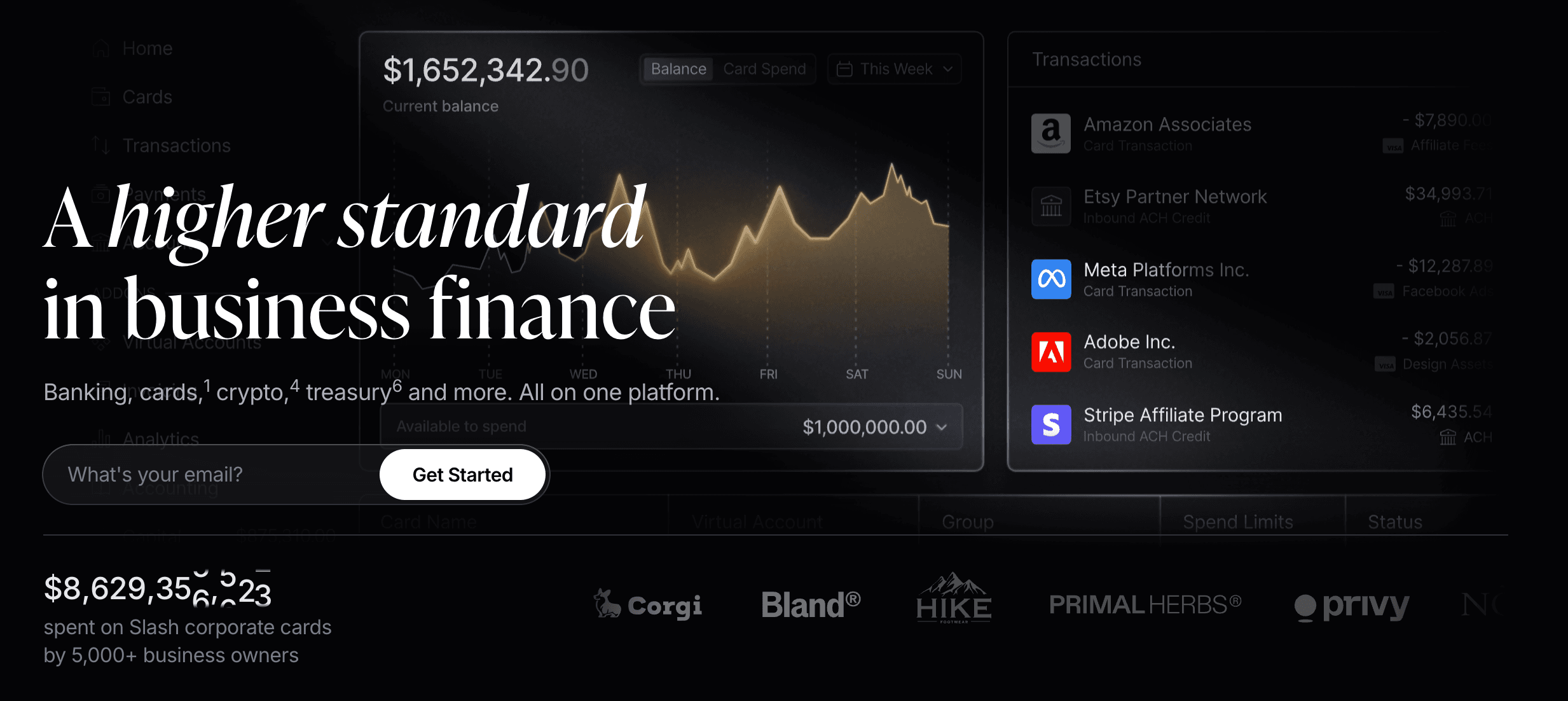
The platform includes capabilities like expense management, automated transfer rules, global USD accounts, and native crypto support. But the real differentiation is in how the system is architected.
Instead of a monolithic bank, Slash brings together the core functions of financial infrastructure into a single, integrated system:
Money movement
Value storage
Card issuance
Bridge powers money movement, while Privy powers the wallet layer where stablecoins live. Rain powers Slash’s global card product, enabling seamless spending from wallet balances, while domestic cards continue to run on traditional fiat rails.
This architecture gives Slash the composability, global reach, and flexibility that traditional neobanks lack, while still delivering the functionality businesses expect.
It also avoids the “walled garden” model. Users can export keys and interact with other services, preserving openness without sacrificing product experience.
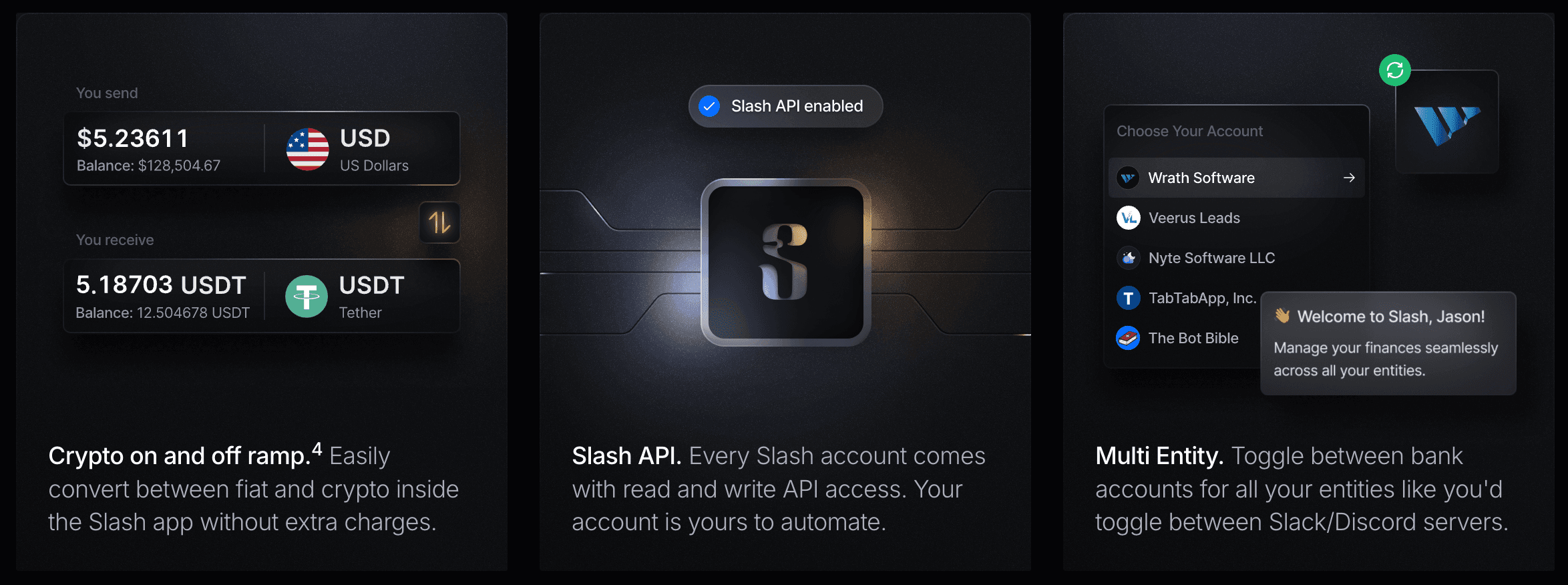
Moving to Privy for a modern financial stack
As Slash expanded its product surface, the wallet layer became critical.
They needed infrastructure that could support:
Granular permissioning and controls
Broad chain compatibility
A secure, production-grade foundation
Initially, wallets were bundled into a broader provider. But over time, it became clear that this layer was too important to compromise on.
Privy stood out for both product quality and execution.
“We had already tried another wallet provider, and it made clear how important this layer is to get right. Once we evaluated Privy, the choice was obvious. It delivered on security, flexibility, and developer experience, and we didn’t see a reason to look elsewhere.” — Andy Jiang, Head of Product of Slash
The migration was fast and seamless. Despite switching providers, Slash saw an immediate lift in security and a simpler developer experience, all implemented by a single engineer in under two weeks.
With Privy, Slash strengthened a foundational part of its stack while continuing to move quickly.
What’s next for Slash
Slash is expanding its platform across both product and infrastructure. Cards are a key near-term focus, with a product that settles fully in crypto without relying on fiat or ACH rails. In Slash’s view, stablecoin-denominated cards unlock global reach, making the full platform accessible to customers everywhere.
Beyond cards, the team is building toward a full financial operating system for businesses, including invoicing, bill pay, and advanced expense management for larger teams.
At the same time, Slash is beginning to reimagine financial workflows around AI. With the introduction of Twin, its AI-powered private banker, the team is exploring how software can take on a more active role in managing finances, not just executing tasks but making decisions alongside users.
Many of today’s financial systems were designed for paper, then adapted for software. Slash believes they are ready to be rethought again, this time with AI at the center.
Wallets play a key role in that future. While AI agents cannot open traditional bank accounts, they can transact through wallets, making them a natural financial interface for software-driven actors.
For now, Slash is focused on building step by step, delivering immediate value while laying the foundation for a new financial system. Privy is proud to power the wallet layer behind that foundation.

