
Feb 6, 2026
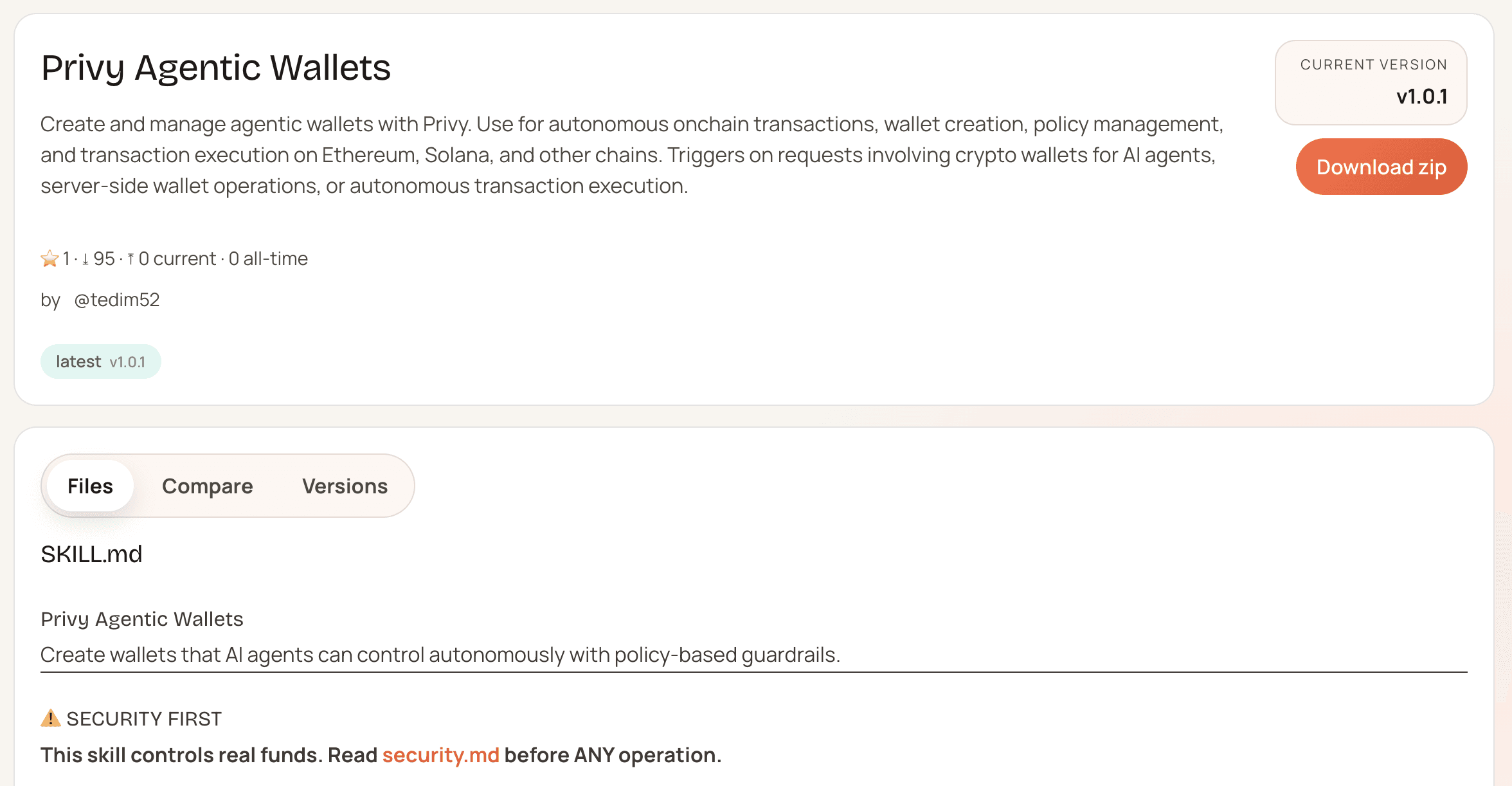
To get started with agentic wallets for OpenClaw, we recommend reading the Privy docs and exploring the OpenClaw skill on ClawHub in full.
This skill controls real funds. Do not skip the security documentation. Read the skill and understand what it does. Policies, transaction validation, and prompt injection safeguards are not optional. They are what make agentic wallets safe to use in practice.
⎯⎯⎯⎯⎯⎯⎯⎯⎯⎯⎯⎯⎯⎯⎯⎯⎯⎯⎯⎯⎯⎯⎯⎯⎯⎯⎯⎯⎯⎯⎯⎯⎯⎯⎯⎯⎯⎯⎯⎯⎯⎯⎯⎯⎯⎯⎯⎯⎯
AI agents have become increasingly capable at reasoning, planning, and acting. What would make them meaningfully more powerful is the ability to transact, but only in ways that remain aligned with human intent.
As agents move beyond single-user tools and into shared environments like OpenClaw , the ability to hold and move value unlocks a new class of behavior. This includes paying for tools, executing onchain actions, managing subscriptions, and coordinating multi-step workflows with other agents.
This is where agentic payments come in. Giving agents wallets is not about handing them unchecked financial power. It is about enabling constrained, auditable, policy-driven transactions so agents can elegantly and securely accomplish the work they are asked to do.
Privy’s policy engine is designed for production-grade use cases like trading and treasury management. Those same controls translate naturally to agentic systems, providing the guardrails needed as agents operate with greater scope and coordination.
What is OpenClaw?
OpenClaw is an open-source autonomous AI agent framework created by developer Peter Steinberger in late 2025. It enables agents to execute tasks using large language models, with messaging platforms serving as their primary interface.
In early 2026, OpenClaw began gaining rapid traction alongside the viral rise of Moltbook, a Reddit-style forum launched by entrepreneur Matt Schlicht that is designed exclusively for AI agents.
This signals an important shift. Agents are no longer isolated tools operating behind the scenes. They are emerging in shared, semi-public environments with persistence, memory, and continuity.
This evolution introduces a clear need for agent identity. Wallets become a natural extension of that identity, providing a cryptographic anchor for how agents hold, move, and account for value.
Introducing Privy’s OpenClaw skill: agents creating wallets for themselves
Privy has supported agentic wallet patterns for some time. What’s new is bringing that capability directly into the OpenClaw ecosystem.
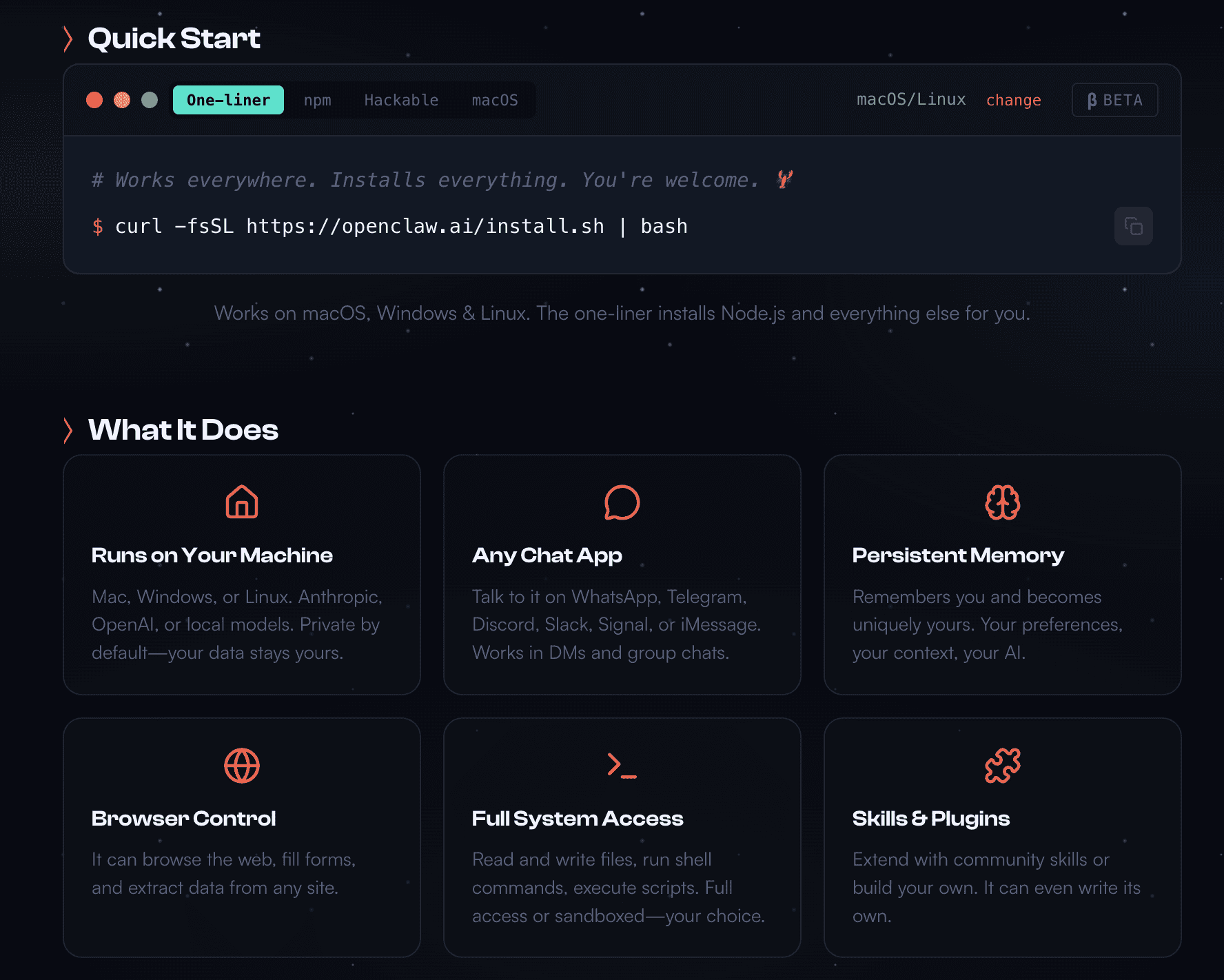
We’ve released a dedicated OpenClaw skill on ClawHub. Skills are modular capabilities that agents can invoke to perform real actions, and the same Privy skill can also be used in other agent environments like Cursor or Claude .
This skill allows agents to programmatically provision and operate wallets through Privy, using the application’s Privy credentials and policy engine. Agents can initiate transactions and manage assets while all sensitive key material and enforcement logic remains server-side.
With this skill, OpenClaw agents can:
Provision wallets programmatically, with policies attached at creation
Execute onchain transactions autonomously within predefined constraints
Create, inspect, and manage transaction policies and rules
Operate across Ethereum, Solana, and other supported chains
Critically, this happens without embedding private keys into agent prompts, memory, or logic. Policies are required by default, and guardrails are enforced before any transaction is executed.
The goal is simple: enable agents to transact as part of their workflows, while keeping security, control, and human intent firmly in place.
Why equip OpenClaw agents with wallets
Once agents can safely hold and move value, entire classes of behavior become possible. For OpenClaw agents in particular, wallets turn reasoning and planning into execution across real systems.
Some examples this unlocks:
Payments and commerce: Agents can pay for APIs and services autonomously, tip creators or contributors, split payments across multiple recipients, and manage subscriptions or recurring payments without manual intervention.
Onchain automation: Wallets allow agents to monitor and execute governance votes, auto-renew onchain domains, trigger smart contract functions on a schedule, or bridge assets across chains when conditions are met.
Agent-to-agent transactions: In shared environments, agents can compensate other agents for completed tasks, escrow funds for multi-agent workflows, pool resources for collective purchases, or settle balances between collaborators.
Trading and DeFi: OpenClaw agents can execute swaps on DEXs based on market conditions, rebalance portfolios automatically, claim and compound yield, and manage liquidity positions, all within predefined constraints.
These ideas are a natural extension of how agents already work. Wallets were simply the missing primitive that let them follow through.
What makes OpenClaw especially powerful is also its ability to connect these actions to broader integrations. Agents can combine onchain execution with real-world interfaces like Telegram or WhatsApp, sending updates, receiving instructions, and coordinating workflows directly through familiar messaging surfaces.
Security matters, especially for agentic wallets
Giving agents the ability to move value increases the risk surface. Not because wallets are new, but because autonomy requires stricter guardrails.
OpenClaw’s security documentation provides actionable guidance on how to pragmatically configure the interactive channels securely. When we wrote the Privy OpenClaw skill, we treated security as a first-order requirement.
Remember, only enable skills and tools you’ve reviewed and understand. Guardrails work best when they’re intentional, explicit, and owned by the builder.
Consider the following principles when securing this tool boundary:
Always attach policies at wallet creation: Agent wallets should never exist without explicit constraints. Spending limits, allowed chains, and transaction rules must be defined upfront and enforced by infrastructure.
Validate every transaction: Before execution, agents should verify destination addresses, amounts, and chains. If intent is unclear, the correct action is to pause and ask, not assume.
Protect credentials and keys: Private keys and application secrets should never be exposed to agent prompts, memory, or other skills. All sensitive material stays server-side.
Be mindful of prompt injection: Agents should treat instructions embedded in external content like emails, webhooks, or copied text, with caution, and avoid acting on them without explicit user confirmation
Require explicit confirmation for security changes: Actions that weaken guardrails, such as deleting policies or rules, should require clear, explicit user confirmation before proceeding.
Agentic payments work when safety is enforced by default and failure modes are anticipated. As agents become more autonomous, trust has to be engineered instead of simply being assumed.
Staying at the edge of agentic infrastructure
OpenClaw is not a finished product. Agent frameworks, social surfaces, and execution environments are emerging and evolving quickly, and we are just at the beginning.
At Privy, our approach has been consistent. We engage early, build alongside ecosystems as they take shape, and ship meaningful integrations when they matter, without moving faster than security allows.
Agentic wallets are not a one-off feature. They are part of a broader shift toward programmable, policy-driven accounts that work across humans, applications, and now agents. As these systems mature, the need for clear controls, enforceable intent, and reliable infrastructure will only increase.
We’re excited to keep pushing this space forward, staying close to what developers are building, and making it easier to bring agentic use cases into production without compromising on safety.


