
Apr 8, 2026
Stablecoins make it possible to move capital instantly, operate globally, and access a growing set of onchain financial markets. For treasury teams, this unlocks new opportunities to deploy capital more efficiently and put working capital to work.
Privy enables teams to do this without moving funds out of their existing custody setup.
Using Privy’s wallet infrastructure, teams can access onchain liquidity, deploy capital into yield strategies, and run programmable workflows at scale while maintaining security and control. Instead of relying on protocol allowlists, Privy enables direct interaction with onchain markets, with policies enforced at execution.
How treasury systems are evolving
Most treasury systems today are designed for security and control, not execution.
They rely on established custody models, approval workflows, and reconciliation processes that are difficult to modify. More importantly, they are often constrained by single-wallet execution, where transactions must be processed sequentially.
This creates two core limitations:
Latency: When all transactions are routed through a single wallet, execution becomes sequential, creating bottlenecks that limit throughput and responsiveness.
Tightly coupled custody and execution: The same wallet that holds funds is responsible for deploying them, making it difficult to access onchain markets without moving capital or introducing new systems.
Together, these constraints make it challenging for treasury teams to operate efficiently or access onchain financial markets without compromising control.
A new approach: separating execution from custody
Privy removes this tradeoff. Instead of routing all execution through a single wallet or moving capital to new systems, Privy introduces an execution layer that sits alongside existing treasury infrastructure.
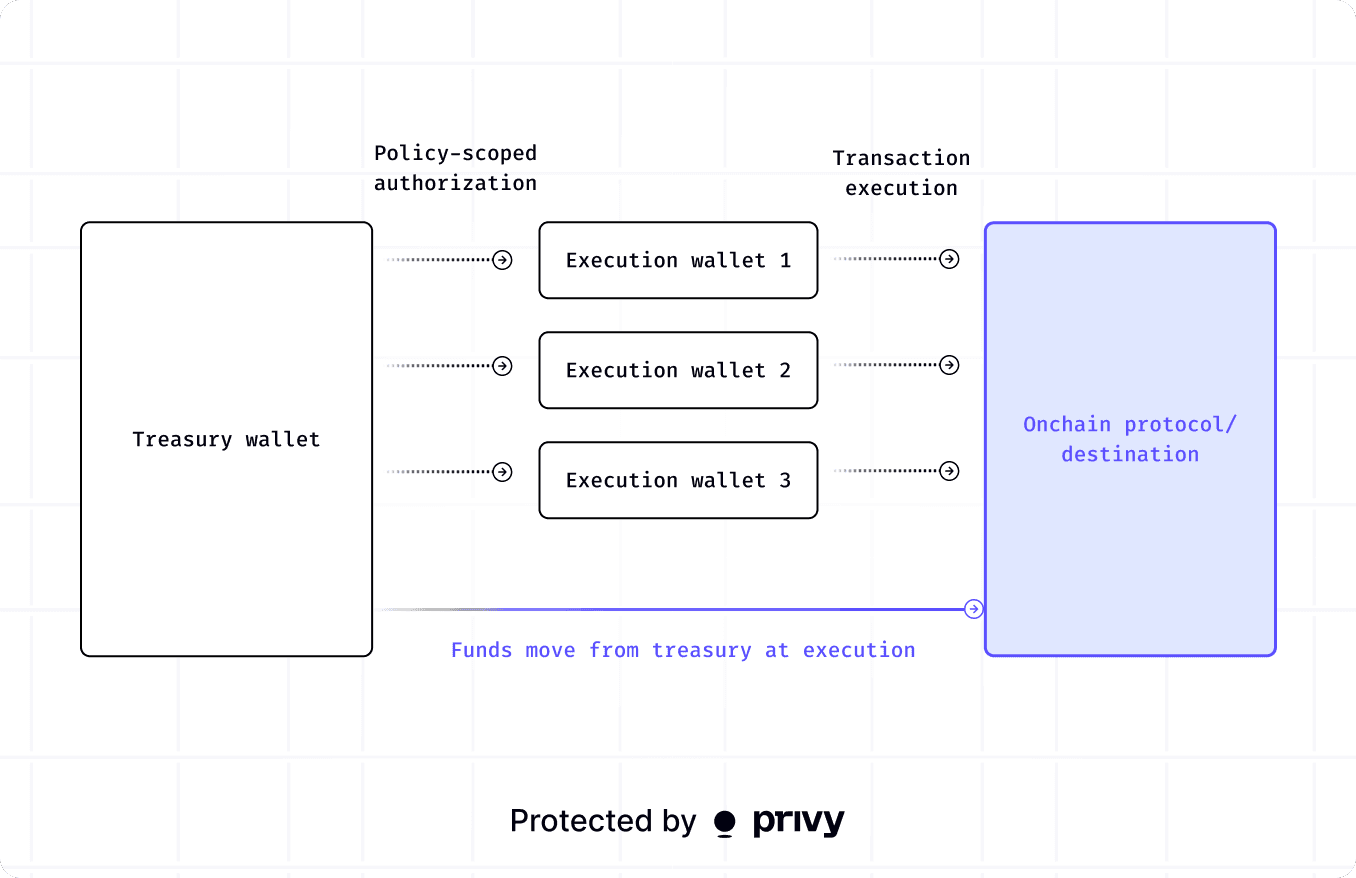
Through execution wallets, teams can parallelize interactions with onchain protocols through a programmable layer while keeping funds in custody. This makes it possible to:
Scale beyond single-wallet, sequential execution: Distribute transactions across a fleet of execution wallets to increase throughput and reduce latency
Access onchain liquidity and lending markets: Interact directly with lending protocols, liquidity pools, and emerging onchain products without relying on protocol allowlists
Automate treasury workflows and capital movement: Trigger transactions programmatically based on events, balances, or policy conditions
Operate without fragmenting liquidity: Keep capital centralized while enabling parallel execution across multiple strategies
How it works
Execution wallets are designed for execution, not storage. They do not replace treasury systems or hold long-term balances. Instead, they act as delegated executors, operating on approved funds under tightly scoped permissions.
Treasury funds remain in custody, while execution wallets are authorized to perform specific actions such as interacting with approved contracts or accessing designated liquidity pools.
Each wallet is governed by policies that define:
Which funds can be accessed
Which contracts can be called
How much can be spent
Under what conditions transactions are allowed
Unlike allowlist-based systems, policies define what is permitted at execution time, enabling access to any onchain protocol while maintaining control. Transactions are constructed as batched operations and evaluated at a granular level before execution, ensuring every action complies with defined policies.
Why this matters
This allows treasury teams to operate faster, scale execution, and access onchain markets without introducing new complexity:
Execute in parallel and reduce latency
Deploy capital into onchain markets without fragmentation or protocol-level restrictions
Automate treasury workflows at scale
Maintain governance as activity increases
Evolve at your own pace
This model is designed to work with existing treasury infrastructure, but it does not limit how teams evolve over time.
Some teams start by adding an execution layer on top of their current custody setup to access onchain markets. Others choose to build fully programmable treasury systems directly on Privy.
Both approaches are supported by the same underlying infrastructure, allowing teams to adopt onchain capabilities incrementally and expand over time without re-architecting.
A new layer for onchain treasury
As stablecoins reshape financial infrastructure, treasury systems need to do more than hold assets securely. They need to move capital in real time, interact with global markets, and support increasingly complex financial workflows.
Privy introduces a programmable execution layer that sits between custody and onchain markets, allowing treasury systems to deploy capital without moving funds or re-architecting their infrastructure.
Explore how to implement execution wallets in our docs .


