Apr 7, 2026
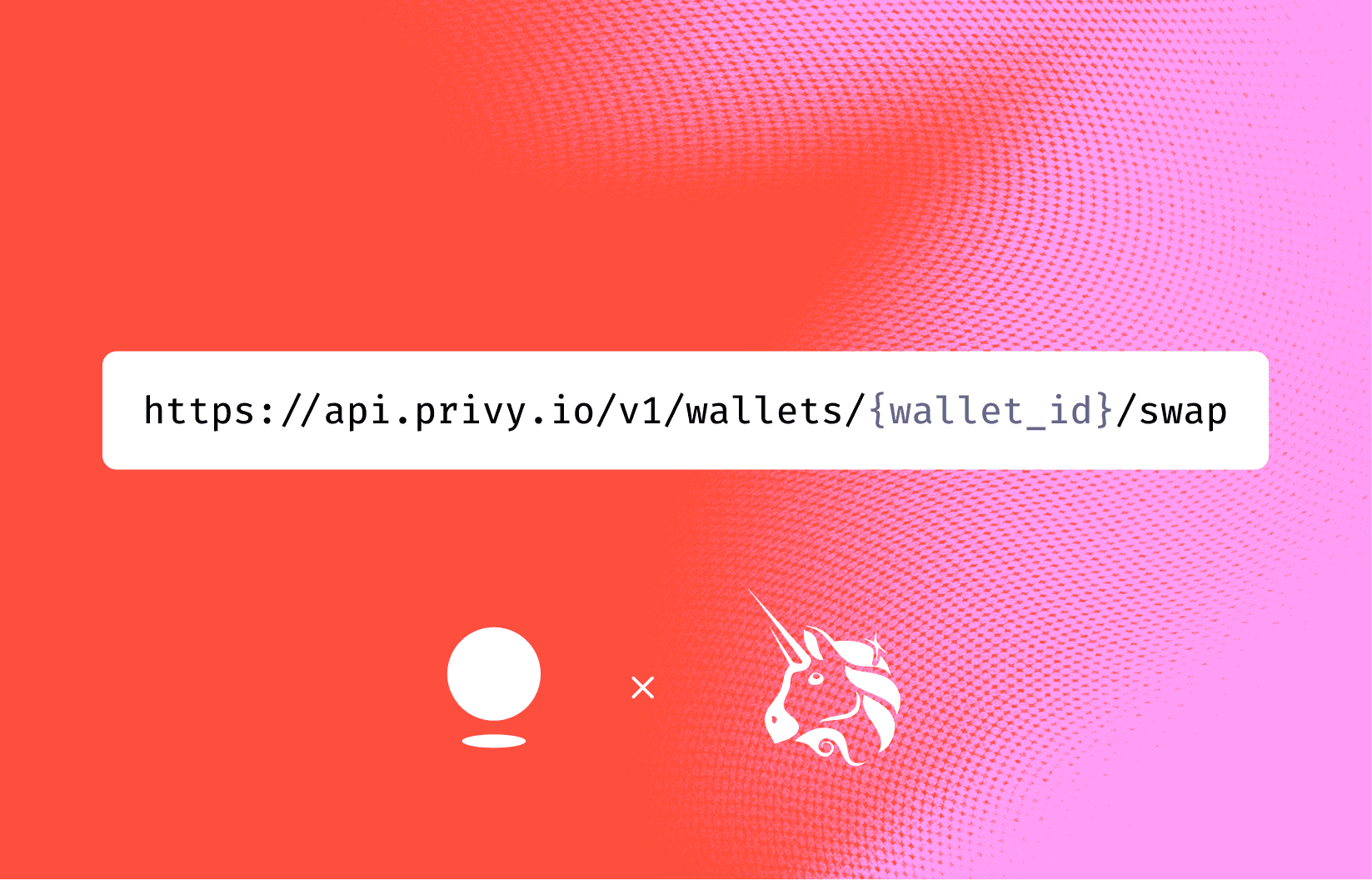
Today, Privy and Uniswap are introducing swaps directly within Privy’s wallet infrastructure.
Developers can now move between assets with a single API call, without needing to manage the complexities of routing, calldata, or execution logic themselves. You can think of this like digital asset FX, built directly into your wallet.
Swaps are powered by the Uniswap API, giving all Privy users access to the protocol that has processed over $4.3T in cumulative volume across 17+ chains and 10M+ assets .
Moving across onchain assets with swaps
Many associate swaps with trading, but in practice, swaps enable applications and users to move between different assets easily.
Users rarely arrive with the exact asset your product needs. They come in with what they have, whether that’s a stablecoin or another cryptocurrency. From there, that balance needs to be converted into something your product can actually use, whether that’s a local stablecoin for payouts, a token used within your app, or a widely supported asset like ETH.
In a remittance flow, for example, funds might arrive in USDC but need to be paid out in a local currency stablecoin. The swap is what makes that movement possible.
Swaps are what turn deposits and balances into actions.
As wallets become the account layer for modern apps, this becomes fundamental. As users hold multiple assets, products need a clean way to move between them.
Improving the developer experience with swaps
For most developers, integrating swaps meant stitching together infrastructure.
You had to:
Source quotes from liquidity pools
Handle routing and slippage logic
Construct calldata
Sign and broadcast transactions
Manage edge cases when transactions fail
This worked for crypto-native teams who understood these mechanics deeply.
But as more developers build in fintech, payments, and agent-driven systems, this level of abstraction starts to break down. Most teams don’t want to think in terms of AMMs (automated market makers, the liquidity pools that power onchain trading) or transaction construction. They want to express intent at a higher level, and have the system simplify the rest.
Swaps, built directly into your wallet infrastructure
By leveraging the Uniswap API, swaps are now built directly into Privy’s wallet infrastructure, becoming part of the wallet instead of something developers have to assemble around it.
A developer specifies the swaps they want to enable, and Privy simplifies the rest, from quoting to transaction construction to execution. There’s no need to manage the complexities of routing logic or reason about how the transaction is encoded.
Instead of living as a separate feature with its own infrastructure, swaps become a natural part of application flows. Conversions can happen exactly when they’re needed, without burdening the developer or the end user with unnecessary complexity.
Powered by Uniswap
Swaps in Privy are powered by the Uniswap API, bringing deep liquidity and reliable execution into your app without requiring custom trading infrastructure.
The result is simpler applications and a more consistent experience for users.
Explore our docs or reach out to [email protected] (mailto:[email protected]) to learn more about swaps for your app.